
Critical Acclaim
Reviews
What critics and readers are saying about Dan Mircea Mrejeru's work
The Making, the Rise, and the Future of the Speakingman
Seventh Edition · 542 pages
April 25, 2026
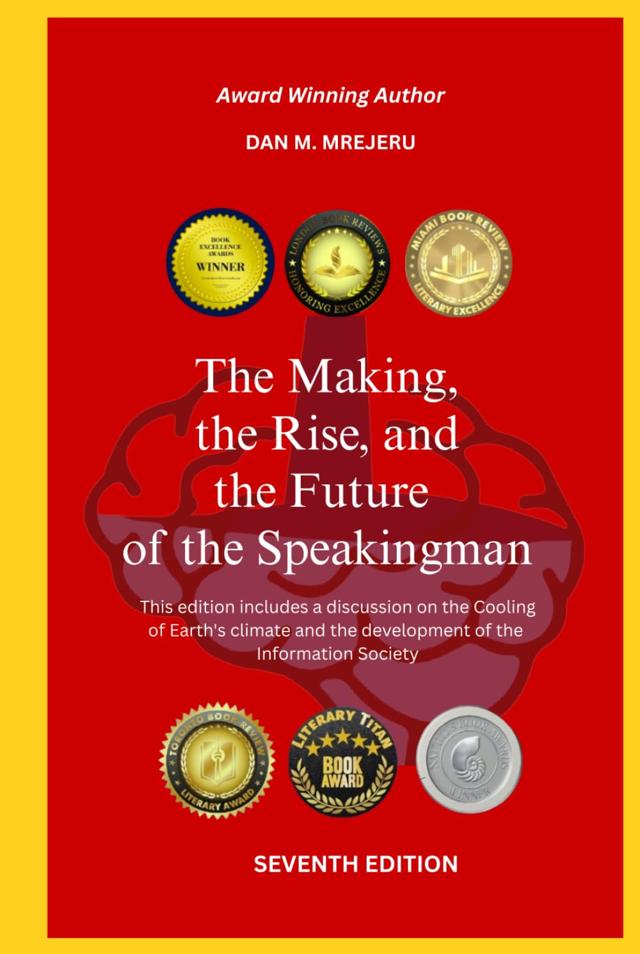
Dan M. Mrejeru's The Making, the Rise, and the Future of the Speakingman is, in its seventh edition, an ambitious work that joins paleoanthropology, neuroscience, climatology, geomagnetism, and civilizational theory into a single interpretive design. Its architecture matters. The book moves from prelinguistic hominin development through migration, cognition, and symbolic culture, then turns toward the future, planetary thermal cooling, and finally the emergence of the Information Society. That breadth gives the volume its proper scale. This is not a monograph in the narrow academic sense. It is a speculative system, a long argument about what kind of creature the human being became, what forces shaped that becoming, and what mental regime may be arriving next.
What gives the book its peculiar identity is the author's insistence that human evolution cannot be understood by anatomy alone. Mrejeru treats the brain as a structure formed under planetary pressures, especially cooling cycles and geomagnetic disturbances, and he frames the human story around two decisive cerebral transformations: one that differentiates late hominins from apes, and another that produces the modern brain. Even the title term, Speakingman, is revealing. It presents humanity less as a biological species than as a being constituted by language, cognition, and collective adaptation. The result is a work that reads as both grand hypothesis and metaphysical anthropology, a theory of how matter, environment, and mind coevolve.
The book's most interesting intellectual gesture lies in its contrast between nonlinear and linear modes of thought. Mrejeru is not content to narrate the emergence of Homo sapiens. He explains shifts in consciousness, the rise of quantification, the growth of individualism, and the possible need for a future hybrid thinking approach. That conceptual range lets the book travel unusually far, from cerebellar development to the political psychology of modernity.
Mrejeru writes like someone trying to assemble a total picture before the fragments drift apart. The book's real subject is not only human origins. It is the author's attempt to think of origins and destiny within one continuum. That is why a phrase from the dedication, I am a nonlinear person, feels more than autobiographical. It reads as a key to the entire enterprise: the book is shaped by a mind that values cross-domain association, recursive analogy, and large explanatory arcs over disciplinary restraint.
As a five-hundred-page intellectual construction, this seventh edition is best read for the pattern it proposes rather than for any single conclusion. Its scale is its argument. What remains most memorable is the seriousness of that wager. Mrejeru believes that the history of the human mind is inseparable from the history of the planet, and he writes as though both histories are entering another phase together. Whether one accepts every step of the argument or not, the book presents itself as a comprehensive anthropology of becoming, and that is what makes it a singular, intellectually provocative work.
Podcast Review
"The book presents itself as a comprehensive anthropology of becoming, and that is what makes it a singular, intellectually provocative work."
Intervista con Dan M. Mrejeru
LiquidArte.it · Italian Magazine
February 13, 2026
By Rosalba Mancuso
Dan M. Mrejeru è un ricercatore indipendente e scrittore appassionato di neuroscience. Rumeno, ma trapiantato negli Stati Uniti e con una laurea in geologia, ha scritto e pubblicato diversi saggi. Il più famoso si intitola The Making, The Rise, and The Future of The Speakingman, una poderosa collezione di studi ed articoli sull'evoluzione dell'umanità, giunta ormai alla sesta edizione.
A Mi considero semplicemente un ricercatore indipendente e multidisciplinare.
A Ricercatore, senza alcun dubbio.
A I primi anni di università hanno fatto maturare in me l'interesse per alcuni fenomeni geofisici e cosmologici e il modo in cui questi ultimi possono influenzare la vita sulla Terra e gli stessi esseri umani.
A Ho iniziato a scrivere il mio primo libro nel 1994, ma l'ho pubblicato solo nel 2006.
A Dodici, fino ad ora, ma molte delle mie opere comprendono anche edizioni aggiornate. Per cui, in totale, includendo le prime edizioni dei libri che ho poi ripubblicato nelle edizioni successive, ho scritto venticinque libri.
A Considero sempre importanti le ultime cose che scrivo, dove annoto le mie ricerche e scoperte più recenti. Rimango davvero stupito delle cose interessanti che scopro e scrivo man mano che procedo con la stesura dell'opera.
A È una domanda molto complessa. Di certo, la cultura generata e alimentata dalle nuove tecnologie sta avendo un impatto molto significativo sulle nostre facoltà umane. Per quanto mi riguarda, considero l'IA un ottimo strumento per risparmiare tempo durante la ricerca di informazioni su particolari argomenti scientifici.
A Sin dall'inizio, ho considerato questo libro un'opera in continua evoluzione, un work in progress. Ecco perché l'ho aggiornato con diverse edizioni. Il libro è ancora in evoluzione. I lettori potranno scoprire i significati delle singole edizioni attraverso la lettura.
A È la colonna portante e l'aspetto fondamentale della mia attività, con cui mi confronto ogni giorno.
A Inizialmente ho descritto l'umanità in regressione, perché negli ultimi quattro-seimila anni ha attraversato una fase di linearità avanzata. Il pensiero lineare è inferiore a quello non lineare, basato sulla creatività e sull'emotività. Da quest'ultimo dipende il progresso. Mi considero una persona non-lineare.
A Il mio lavoro mi ha guidato verso idee che non avrei mai immaginato. Nel mio ultimo testo scientifico, disponibile su Academia.edu, descrivo ancora il fenomeno geologico dell'abbassamento della temperatura e di come ciò abbia supportato l'evoluzione della nostra civiltà. Questa ricerca si è rivelata per me un'avventura formidabile, quasi un'ossessione. Adoro scrivere la storia dell'evoluzione umana. Spero tanto che i lettori amino leggerla.
"Questa ricerca si è rivelata per me un'avventura formidabile, quasi un'ossessione. Adoro scrivere la storia dell'evoluzione umana."
Dan M. Mrejeru, LiquidArte, 2026